The global wellness economy reached an estimated $7.5 trillion in 2025, and spas are one of its fastest-growing sectors. That is the headline from the Global Wellness Institute's newly released 2026 monitor. Behind the number is a more useful story: people are spending on places that combine recovery, travel, bathing, beauty, community and credible care.
Released on November 11, 2026, the report projects $8.2 trillion in 2026 and $10.9 trillion by 2030. Spas grew 12.8% from 2024 to 2025; wellness tourism rose 11.4%; thermal and mineral springs increased 10.4%. The figures reveal where demand is moving, not which individual businesses will win.
A spa visit can now be the reason for a trip, part of an urban recovery day or a shared thermal ritual. This analysis turns the latest research into five practical spa trends to watch in 2027.
New data
The wellness economy is growing faster than the wider economy
GWI covers eleven sectors, so $7.5 trillion is not a spa-industry figure. It places spa revenue at about $184 billion in 2025 and projects $270.1 billion by 2030, an estimated 8% annual growth rate.
ISPA's 2026 Big Five adds a US signal: $23.5 billion in 2025 revenue, 191 million visits, 22,060 locations, 376,900 employees and $123.10 revenue per visit.
Outlook
Five spa trends shaping 2027
1. Wellness travel becomes a primary trip motive
GWI estimates wellness tourism grew 11.4% between 2024 and 2025 and forecasts $1.38 trillion by 2030. Urban recovery weekends, sleep-focused stays, nature immersion and heat rituals are broadening the category. The winning experience is coherent from room and food to treatment timing.
Cities can compete with resorts. Our Bangkok spa day itinerary shows urban recovery in practice; the best spas guide compares day spas, resorts and retreats.
2. Social bathing returns as an antidote to isolation
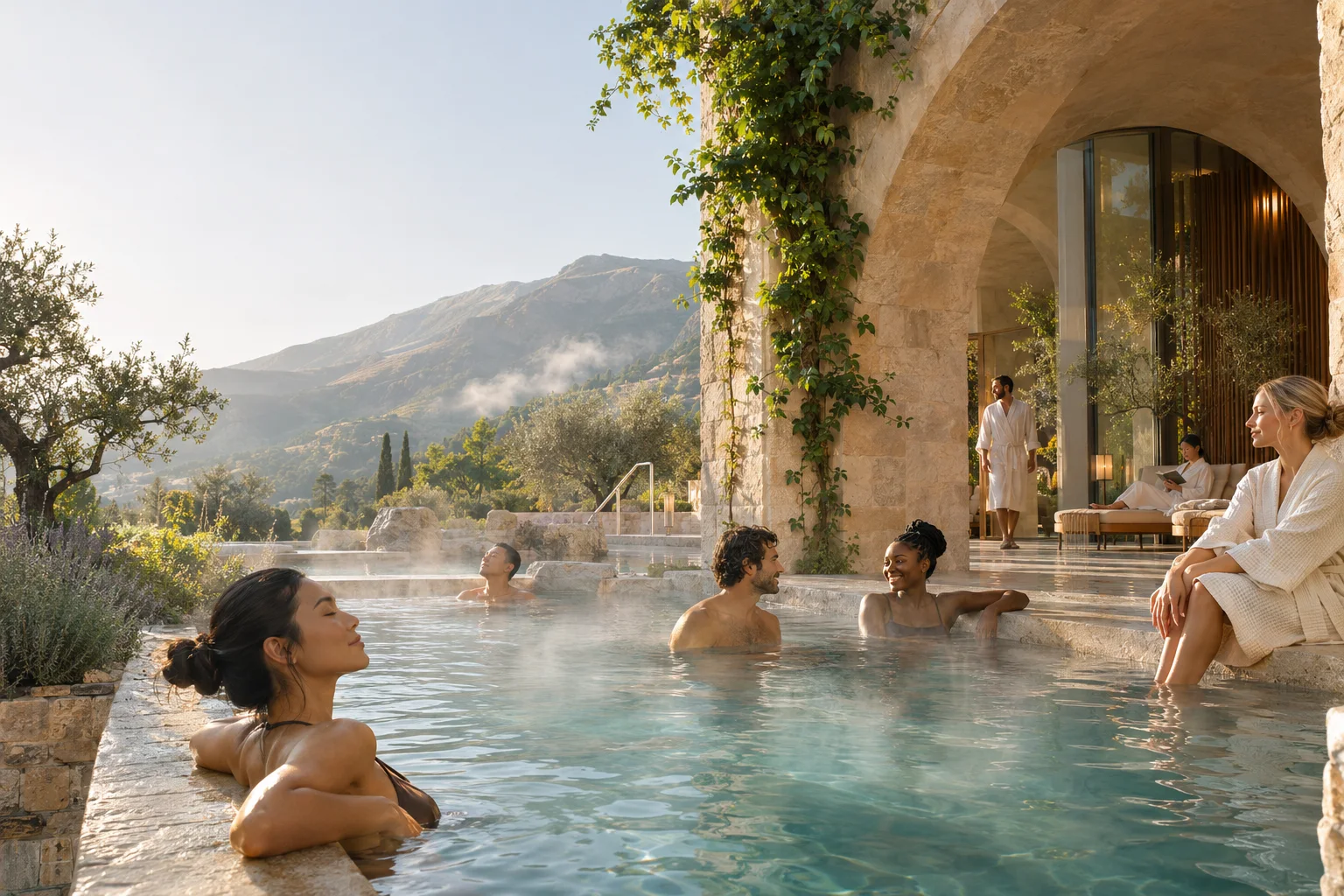
Thermal and mineral springs grew 10.4% and are forecast to reach $124.5 billion by 2030. Sauna rounds, hammams and communal pools provide ritual, sensory focus and low-pressure social time, making urban bathhouses newly relevant.
Social does not mean careless. Temperature, hydration, alcohol, pregnancy, medication and cardiovascular conditions can change what is appropriate. Good venues explain the circuit and offer both quiet and sociable zones.
3. High-tech recovery meets high-touch service
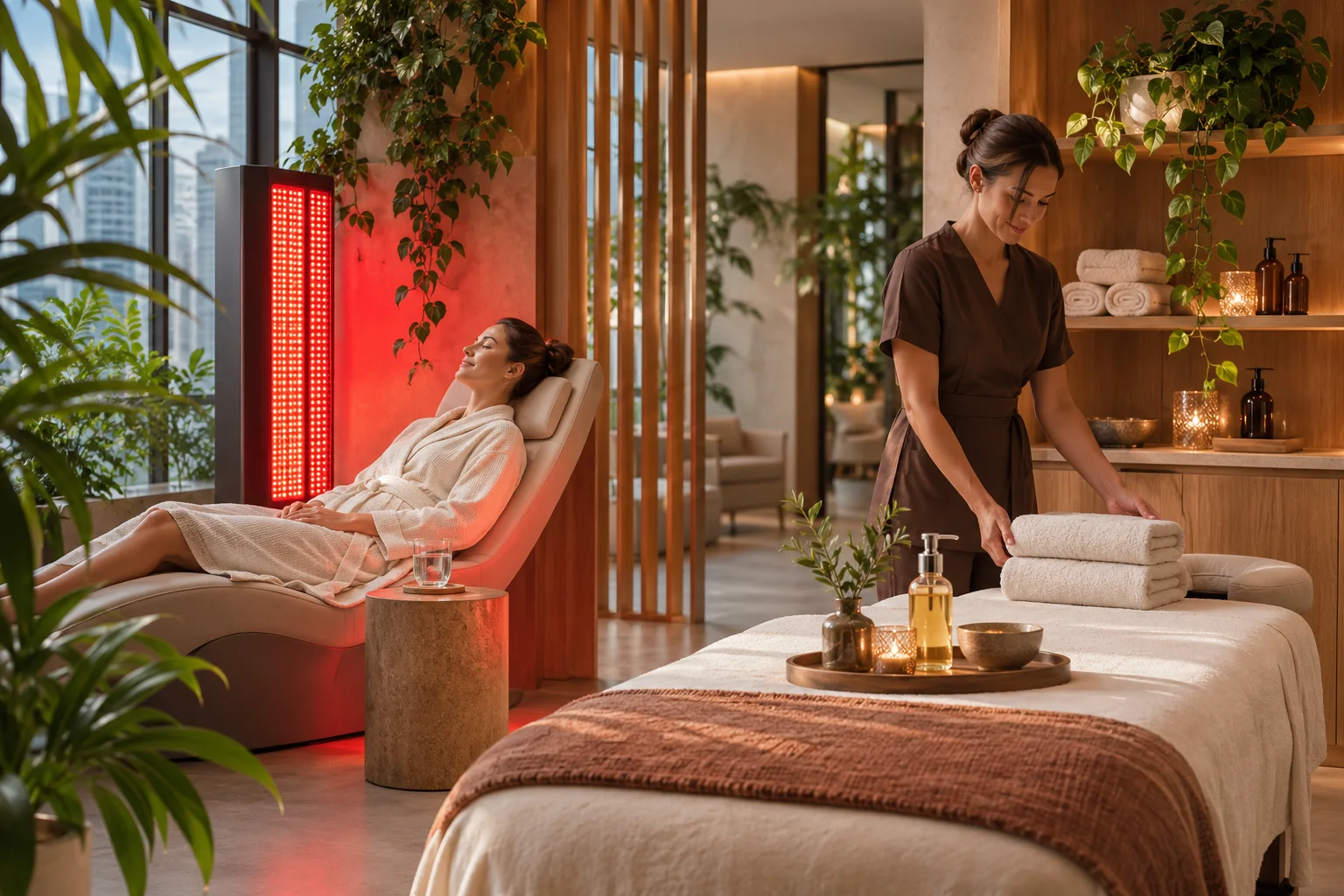
Infrared heat, LED, cryotherapy and automated massage are entering wellness menus. Technology can create repeatable settings, but the device is not the experience. Consultation, contraindication screening and adaptation remain decisive.
More technology requires clearer evidence, limits and supervision. The credible hybrid model is simple: a device supports a defined goal; trained people personalize and protect the guest.
4. Nervous-system recovery replaces vague “detox” language
Deep rest, privacy and nervous-system reset answer a recognizable problem: overstimulation. Guests want lower light, quieter arrival, fewer decisions and time after treatment. Spas can respond through acoustics, pacing and recovery space without making medical claims.
Calm cannot survive a noisy reception or rushed turnover. See our guides to service design and spa front-desk operations.
5. Beauty shifts from instant correction to skin longevity
Beauty is moving toward barrier health, sun protection, sleep and repeatable care. The Global Wellness Summit calls this skin longevity: supporting function over time rather than chasing one dramatic before-and-after.
Not every “longevity” claim is scientific. Credible facials name the method, downtime, contraindications and realistic outcome. Compare non-injectable options in our evidence-led face gym guide.
Regional signal
Asia is growing quickly—but authenticity cannot be copied
GWI says wellness-tourism spending in Asia grew 15.6% from 2024 to 2025. Bathing traditions, massage lineages, dense cities and resort investment create exceptional potential—and a temptation to package culture as decoration.
Travelers should seek trained practitioners and honest origin stories. Operators should credit traditions, work with local expertise and resist generic “Asian wellness” menus.
Practical response
What spa operators should do with this trend
- Build around a guest problem. Sleep, travel fatigue, tension, skin maintenance and social recovery are clearer than a list of machines.
- Design the full journey. Booking, arrival, consultation, transitions, payment and after-care influence the result guests remember.
- Explain every claim. Separate comfort, cosmetic appearance and medical outcomes; disclose limits and contraindications.
- Protect human skill. Invest in therapist training, pacing and retention before buying technology that staff cannot explain.
- Create a useful entry point. A half-day urban reset or guided thermal circuit can welcome people who are not ready for a week-long retreat.
The latest figures justify confidence, not complacency. More demand will bring more competition and more scrutiny. The operators most likely to benefit are those that make wellness easier to understand, safer to choose and better to remember.
Watch
Two official research explainers
These Global Wellness Institute webinars provide background on how the wellness economy and wellness tourism are defined. They are contextual explainers rather than substitutes for the November 2026 report.
Wellness Economy Research Webinar
Global Wellness Institute researchers explain how the wellness economy is measured and why the sector matters.
Wellness Tourism: Wellness Economy Webinar Series
A Global Wellness Institute background webinar on wellness tourism and the forces shaping this travel category.
FAQ: spa trends and wellness tourism in 2027
How big is the global wellness economy in 2026?
The Global Wellness Institute estimates that the wellness economy reached $7.5 trillion in 2025 and projects it to reach $8.2 trillion in 2026. The same report forecasts $10.9 trillion by 2030. These figures cover eleven sectors, so they are much broader than spas alone.
What are the most important spa trends for 2027?
The clearest signals are the continued rise of wellness tourism, renewed interest in thermal and social bathing, a blend of evidence-led technology with skilled human touch, nervous-system recovery, sleep and longer-lasting skin health. The strongest operators will connect these ideas to a clear guest need rather than simply adding fashionable equipment.
Is wellness tourism still growing?
Yes. GWI reports that wellness-tourism expenditure grew 11.4% from 2024 to 2025 and forecasts annual growth of 7.1% through 2030. Asia recorded 15.6% year-on-year growth in wellness-tourism spending, but regional growth does not guarantee that every retreat or hotel spa offers the same quality.
Why is social bathing becoming popular again?
Thermal pools, saunas, hammams and communal bathing answer several current needs at once: recovery, ritual, time away from screens and low-pressure social connection. GWI reports that the thermal and mineral springs sector grew 10.4% from 2024 to 2025, supporting the broader revival of bathing culture.
Will spa technology replace massage therapists?
The market evidence points more toward hybrid experiences than replacement. Infrared, LED, cryotherapy and other technologies can add consistency or a specific recovery format, while consultation, adaptation, touch and trust remain human strengths. A device should have a clear purpose, trained supervision and transparent safety guidance.
Sources and methodology
This article prioritizes primary industry research released or current in 2026. Forecasts are presented as projections, not certainties. Market figures were cross-checked against the publisher's release, report page and detailed report; US operating figures come from ISPA.
- Global Wellness Economy Monitor 2026 press release: for the $7.5 trillion market estimate, sector growth and 2030 forecast.
- Global Wellness Institute 2026 report page: for the methodology and full research publication.
- Global Wellness Economy Monitor 2026 PDF: for the detailed tables, regional results and sector projections.
- ISPA 2026 Big Five statistics: for United States spa revenue, visits, locations, revenue per visit and employment.
- GWI Wellness Tourism Initiative trends: for current travel themes including urban recovery, heat rituals, deep rest and nervous-system reset.
- Global Wellness Summit skin-longevity trend: for the shift from rapid correction toward longer-term skin health.
Editorial note: this report is educational market analysis. It does not provide medical advice or endorse every treatment, device or venue mentioned. Editorial images were created for Beauty Spa Hub and do not depict a specific property.