Writing about the best spas in the world requires more than a list of beautiful pools and famous hotel names. A spectacular setting may attract attention, but a truly exceptional spa is defined by something quieter: the intelligence of the consultation, the confidence of the therapists, the pacing of the experience, the integrity of the wellness program, the cultural depth of the rituals and the way the guest feels after the treatment has ended.
The global spa market has changed dramatically. The spa is no longer only the humid zone of a luxury hotel where guests book a massage between appointments. It can now be a complete destination: a preventive wellness clinic, a longevity retreat, a thermal sanctuary, a private island resort, a serious hammam, a technology-led urban spa, a holistic house or a full program for sleep, nutrition, movement and recovery. That makes rankings more useful, but also harder to interpret.
The best spa for an exhausted executive is not necessarily the best spa for a honeymoon couple, an athlete in recovery, a traveler seeking a high-performance facial or someone who simply needs to sleep properly again. This guide therefore takes an editorial approach rather than pretending that one universal podium can answer every need. It explains the signals that matter, the categories that shape international awards, the destinations that define the market and the practical questions to ask before booking.
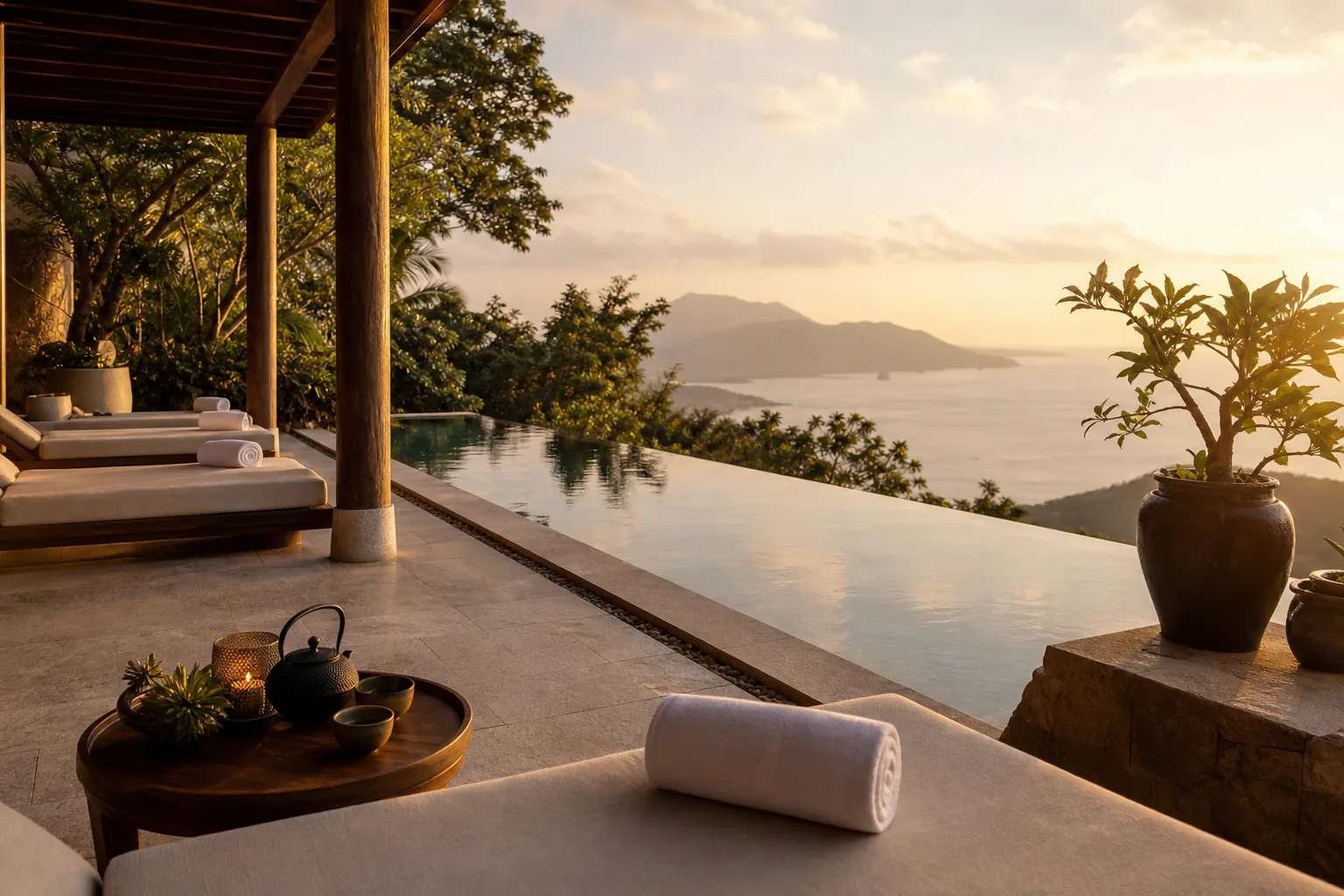
Table of contents
- How to judge the best spas in the world
- What spa rankings really reveal
- The main families of exceptional spas
- The addresses and destinations shaping the market
- The invisible criteria that change everything
- How to book without making the wrong choice
- The trends defining great spas now
- Comparison table
- FAQ
1. How to judge the best spas in the world
An excellent spa cannot be judged only by price, square footage, celebrity reputation or the number of treatment rooms. The best places create a sense of coherence before the treatment begins. Booking is clear. Arrival feels calm. The intake form is not treated as an empty administrative gesture. The therapist listens. Pressure is confirmed. Products are recommended with restraint rather than pushed as automatic add-ons. Recovery time after the treatment is treated as part of the experience, not as a corridor between the treatment room and the cashier.
The first test is alignment between promise and execution. If a spa speaks about longevity, it should offer more than a relaxing massage under a fashionable label. The program should include appropriate assessments, movement, nutrition, sleep support, follow-up, expert supervision and careful language around results. If a hammam claims cultural depth, the ritual must be respected through steam, exfoliation, rest, privacy and hospitality. If an island resort sells reconnection with nature, the silence, light, cuisine, materials and transitions should all support that promise.
The second test is human judgement. In the best spas, luxury is not merely material; it is behavioral. Staff know when to speak and when to stay quiet, when to recommend and when to give space, when to adapt a protocol and when to refuse a request that makes little sense for safety, skin condition or recovery. This level of judgement cannot be bought with marble. It comes from training, management, service culture and a stable operating system.
The third test is memory. A great spa does not simply feel pleasant for 90 minutes. It leaves the guest with a clearer way to slow down, breathe, sleep, care for the skin or inhabit the body. That is often the difference between a good spa and a spa people remember and recommend years later.
2. What spa rankings really reveal
International rankings are useful when read as maps rather than absolute truths. The World Spa Awards, for example, recognize very different categories: resort spas, hotel spas, wellness retreats, day spas, medical spas, destination spas, eco spas, hammams, spa design, wellness clinics and signature treatments. Forbes Travel Guide approaches luxury through inspection and service standards. Travel magazines, hotel guides and specialist platforms add the voices of readers, inspectors or industry professionals.
For editorial research, Spa Awards is a useful reference point because it gathers award signals by geography and spa type. It should not replace personal due diligence, but it helps identify properties that repeatedly appear in professional conversations and makes it easier to compare Bangkok, Europe, North America, Asia and island destinations through a more structured lens.
The right way to use any award is to ask what exactly has been recognized. Was the spa honored for design, service, medical programming, destination appeal, innovation, sustainability, a signature treatment or the total guest experience? A resort spa recognized in an island category does not promise the same thing as a clinic recognized for longevity. A city spa celebrated for service should not be compared directly with a seven-day mountain retreat.
This caution matters because wellness has become a highly visible market. Words such as detox, biohacking, anti-aging, cellular health and longevity are powerful attention magnets, but their value depends on supervision and context. The best spas avoid easy miracles. They explain limits, ask better questions, adapt protocols and distinguish clearly between comfort care, preventive wellness and medical intervention.
3. The main families of exceptional spas
To understand the global spa market, it helps to separate the major families. The palace or luxury hotel spa is the most familiar. It offers impeccable service, beautiful rooms, signature treatments, often a prestigious product partner and a very high level of comfort. Guests choose this type of spa for the assurance of a seamless experience, especially in major capitals and five-star resorts. It excels when it turns a hotel stay into a coherent restorative pause.
The destination resort spa depends more heavily on place. The Maldives, Greece, Thailand, the Seychelles, Bali, Arizona, Tuscany and the Alps all use nature as part of the treatment. A strong resort spa does not rely on a beautiful view alone. It uses light, food, movement, local ritual, sleep and the rhythm of the stay to create a gradual recovery arc. Guests often come because they need distance from their daily environment.
The wellness retreat goes further. It offers a program, sometimes over several days or weeks, with guided activities, menus, consultations, movement, meditation, sleep work, thermal bathing, massage, body treatments or holistic practices. Names such as Chiva-Som in Thailand, Palazzo Fiuggi in Italy, SHA in Spain and Mexico, JOALI BEING in the Maldives, Six Senses in several destinations and American retreats such as Canyon Ranch and The Ranch Malibu belong to this broader conversation.
The medical spa or wellness clinic follows another logic. Here, vocabulary must be more precise. The experience may include assessments, nutrition, testing, prevention, rehabilitation, supervised programming and, in some cases, medical devices or clinical oversight. Lanserhof, Chenot, SHA and Clinique La Prairie occupy this imagination. These places can be remarkable, but they require a more demanding reading of qualifications, indications, contraindications, follow-up and transparency around what is wellness, what is prevention and what is medical care.
Finally, the urban day spa remains essential. An exceptional day spa may be more useful than a distant resort for someone living or traveling through New York, Paris, Bangkok, Dubai, London, Singapore or Tokyo. The best day spas win through consistency: welcome, punctuality, reliable therapists, hygiene, facial care, massage, hammam, nails, grooming and the ability to create a real pause without turning the day into a logistical project.
4. The addresses and destinations shaping the market
A serious guide to the best spas in the world has to mix styles. In Europe, Italy and Switzerland often dominate conversations around thermal culture, prevention, mountain recovery and medically supervised programs. Palazzo Fiuggi represents the ambitious wellness retreat, where nutrition, movement, treatments, rest and a historic setting work together. Chenot Palace Weggis and Clinique La Prairie represent the Swiss tradition of precision, supervision and longevity. Lefay Resort & SPA Lago di Garda, Grotta Giusti and leading Alpine spas add a more sensory dimension, combining nature, water, design and hospitality.
The Mediterranean has become a powerful wellness stage. In Greece, properties such as Mandarin Oriental Costa Navarino and One&Only Kea Island show the appeal of hospitality built around sea, low architecture, local rituals and international standards. In Spain, SHA has helped define a structured approach to prevention, nutrition, movement and long-term wellbeing. In Morocco, Royal Mansour Marrakech and Royal Mansour Casablanca remind travelers that a hammam, when executed with rigor, can feel as sophisticated as a high-tech protocol.
Asia remains one of the great laboratories of spa culture, and Thailand is central to that story. The country has a deep language of massage, welcome and ritual that feeds both iconic retreats and urban spas. Chiva-Som has long been a reference point for destination wellness in Hua Hin. Bangkok, meanwhile, blends palace spas, boutique houses, traditional bodywork and newer recovery concepts. If you are building a coherent day in the city, our Bangkok spa day itinerary offers a practical method for sequence, transport and after-care.
India and the Himalayas add another kind of depth. Six Senses Vana, Ananda in the Himalayas and related retreats combine yoga, Ayurveda, meditation, nutrition, nature and rest in a way that feels less spectacular than transformative. Their success depends on a gentle discipline: enough structure to help the guest change rhythm, enough hospitality to keep the experience from feeling punitive.
The Maldives, the Seychelles and the Indian Ocean excel in the imagination of disconnection. JOALI BEING, Waldorf Astoria Spa Maldives Ithaafushi and other private island resorts build experiences where water, silence, villas, sky and intimacy become part of the treatment. The risk in these destinations is confusing the beauty of the place with the quality of the spa. The best properties avoid that mistake by adding real expertise, strong practitioners, coherent programs and hospitality that does not depend on the scenery alone.
In the United States, Arizona, California, New York and Texas show several faces of contemporary spa culture. Canyon Ranch Tucson, The Ranch Malibu, Lake Austin Spa Resort and WORLD SPA in New York do not play the same score. One works through immersive wellness and lifestyle habits, another through effort and nature, another through lakeside comfort, another through urban access and global bathing traditions. The contrast is useful because it proves that the best spa is never abstract. It is best for a specific context.
5. The invisible criteria that change everything
The first invisible criterion is diagnosis. A great spa does not begin by selling the most expensive treatment. It tries to understand the guest. What kind of fatigue is present? What is the skin condition? How is sleep? What level of pressure is appropriate? What has the guest tried before? What happens after the session? A short but intelligent consultation is more valuable than a long marketing speech because it shows that the spa can personalize without improvising.
The second criterion is rhythm. The best spas understand that luxury is often a question of perceived time. Arrival, changing, tea, treatment, recovery, payment and departure can either support calm or interrupt it. Memorable spas have gentle choreography. Nothing feels rushed, but nothing drifts. The guest is guided without being managed too heavily.
The third criterion is visible hygiene. In a market where official photography can look perfect, concrete cleanliness is decisive: linen, floors, tools, wet areas, oils, glasses, showers, combs, devices, nail stations, sandals and ventilation. Hygiene should not be hidden; it should reassure without making the space feel clinical. This is especially important for facials, waxing, nails and thermal environments.
The fourth criterion is restraint in claims. A credible spa can speak about relaxation, sleep, recovery, more comfortable skin, mobility, breathing, stress and habits. It should be careful with medical language and guaranteed outcomes. The best houses understand that trust comes as much from what they refuse to promise as from what they know how to deliver.
The fifth criterion is after-care. Many spas end too quickly. The best ones explain what to drink, what to avoid, when to resume exercise, how to protect the skin, when to return, which product to use sparingly and which signals should be watched. For facial care, our guide to Hydrafacial, Kobido, Gua Sha and modern facial techniques explains why the protocol matters as much as the treatment room.
6. How to book without making the wrong choice
Before booking, define your intention in one sentence. "I want to recover after a long-haul flight" does not require the same spa as "I want a facial before a wedding", "I want to understand my sleep", "I want a week of fitness and nutrition support" or "I want a culturally precise hammam." That sentence protects your budget. It keeps you from choosing the most famous property when a more specific address would serve you better.
Then read the menu like an editor. Strong menus explain duration, sequence, products, contraindications, included spaces, recovery time and intensity. If the menu stacks vague wellness language without explaining the experience, ask questions. If a multi-day program promises deep transformation without describing assessment, safety, limits or personalization, be cautious.
Look at unofficial photos and recent reviews. Brand photography shows intention; reviews often reveal operations: waiting time, noise, therapist quality, commercial pressure, cleanliness, temperature, organization and follow-up. A great spa can have an occasional negative review. What matters is repetition. The same complaint appearing again and again usually signals a system issue.
Contact the spa before expensive reservations. Ask which practitioner is suitable for your goal, whether the program is appropriate for your health context, how much time to allow before and after, what is included, what is not included and how cancellation works. For an international wellness retreat, ask for a sample daily schedule. For an urban spa, ask whether facilities can be used before or after the treatment.
Finally, prepare your body and your calendar. Do not place a deep treatment between stressful obligations. Hydrate, eat lightly, arrive early, mention sensitivities and protect a calm window after the appointment. The best spas can do a great deal, but they cannot turn a poorly planned booking into a perfect experience. To choose the right treatment family, start with our spa treatment selection guide, then adapt it to the destination.
7. The trends defining great spas now
The first trend is longevity, but in its best versions it has become more intelligent and less theatrical. Guests are not simply trying to look younger. They want to understand energy, sleep, inflammation, strength, skin, stress and recovery capacity. Serious properties translate that interest into habits and support, not absolute promises.
The second trend is restrained personalization. Guests want to be recognized, but they do not always want to be measured, scanned, upsold or placed inside a rigid protocol. Great spas find the balance between data, human intuition and hospitality. They ask enough questions to personalize, but not so many that rest begins to feel like an audit.
The third trend is the return of ritual. Hammams, bathing circuits, thermal culture, saunas, manual massage, breathwork, walking, silence, plants, local cuisine and sleep have regained value in a world fascinated by technology. This does not mean nostalgia. It means the body still responds to simple things when they are carefully staged: heat, water, touch, rest, light and rhythm.
The fourth trend is the total experience. The best spas now care about the room, the bed, the food, the scent of corridors, the sound of doors, the timing of checkout, the content sent after departure and the way a guest can continue at home. A spa becomes truly world-class when it understands that care does not begin with oil and does not end with a warm towel.
8. Comparison table: which type of spa should you choose?
| Spa type | Best for | Example destinations | What to verify |
|---|---|---|---|
| Palace spa | Impeccable service, short luxury treatments, low friction | Paris, London, Dubai, Hong Kong, New York | Practitioner quality and recovery time included |
| Resort spa | Romantic stays, disconnection, nature, hospitality | Maldives, Greece, Bali, Seychelles, Thailand | Real expertise beyond the view |
| Wellness retreat | Sleep, stress, fitness, nutrition, lifestyle reset | Italy, Thailand, India, Arizona, California | Program structure, supervision and personalization |
| Medical spa or clinic | Prevention, assessments, longevity, nutrition, follow-up | Switzerland, Germany, Spain, Mexico | Qualifications, limits and medical transparency |
| Urban day spa | Massage, facial care, hammam, short pause, grooming | Bangkok, New York, Paris, Singapore, Tokyo | Hygiene, punctuality and consistency |
| Thermal spa | Heat, mineral water, bathing circuits, gentle recovery | Italy, Austria, Switzerland, Japan, Iceland | Temperature, contraindications and exposure time |
Conclusion: the best spa is the one that keeps its promise
The best spas in the world do not all look alike, and that is the point. Some impress through architecture, others through discipline, thermal heritage, service intelligence, connection to nature or the depth of a multi-day program. The great ones have one thing in common: they keep their promise without forcing it. They know what they are, who they are for and which limits they must respect.
For the traveler, the real question is not "which spa is number one?" The better question is "which place understands my need better than the others?" A guest who simply wants to feel calmer after a long flight does not need a longevity clinic. Someone seeking a real sleep reset may need several days, a nutritional framework and a gentle program. A beauty-focused traveler may find the perfect answer in an exceptional facial if the diagnosis and after-care are precise.
Modern luxury is less noisy than it used to be. It is not proved only through rarity or price. It is proved through attention. A great spa welcomes without overwhelming, treats without selling miracles, slows the guest down without patronizing them and leaves behind something more durable than a photograph: a renewed confidence in the body's own rhythm.
FAQ: best spas in the world
What is the best spa in the world?
There is no single best spa in the world for every traveler. A preventive medical wellness clinic in Europe, a longevity retreat in Asia, a private island resort in the Maldives and a refined urban day spa in New York answer very different needs. The right choice depends on service quality, practitioner expertise, program coherence, medical or non-medical context, destination, budget and the personal result you want from the experience.
How can you recognize a truly high-end spa?
A high-end spa is defined less by decoration than by precision: a clear consultation, visible hygiene, calm pacing, trained therapists, adaptable protocols, coherent products, quiet recovery spaces and useful after-care. Awards and rankings can be helpful signals, but they should always be read alongside recent reviews, current photographs, qualifications and the real positioning of the property.
Should you choose a hotel spa, a wellness clinic or a day spa?
A hotel spa is ideal for a luxury stay or a short restorative break. A wellness clinic or specialized retreat is better for deeper goals such as sleep, stress, nutrition, fitness, supervised detox or longevity. A day spa is best for a focused treatment, an urban pause, a massage, a facial or a recovery ritual without committing to a full wellness trip.
Are spa awards reliable?
Spa awards are useful reputation signals when their categories, methodology, geographic coverage and judging criteria are clear. They do not replace personal due diligence. Before booking, read recent reviews, examine unfiltered photos, check qualifications, understand what is included and contact the spa if the trip or program is expensive.
How much does a world-class spa cost?
Prices vary widely. A premium urban day spa may charge a high but manageable price for a 90-minute treatment, while an international wellness retreat can cost several thousand dollars for a few days including accommodation, assessments, activities and meals. The fairest comparison is not price per minute, but the level of expertise, personalization, facilities and support included.
Continue planning with Beauty Spa Hub
If you are preparing a more concrete spa experience, start by comparing treatment families on the Beauty Spa Hub services menu. For recovery and rest, read our guide to sleep, stress and beauty recovery. If your priority is clearer skin before travel or an event, the facial techniques guide will help you ask better questions before booking.